✦ Your AI study companion

Understand it.
Remember it.

Works with your own books, notes and lectures. It explains every chapter, makes sure it sticks, and tells you exactly what to study next.

  • Free forever plan
  • No credit card
  • Phone, tablet or laptop
Your Knowledge Base

Bring anything you study. StudyTab puts it in order.

Add a textbook chapter, a lecture video or a photo of your notes. StudyTab files it by subject, reads it and makes flashcards. Then you choose how to see it all.

  1. 1

    Bring anything

    Tap one to add it, or drag it into the window.

  2. 2

    It lands in your Knowledge Base

    Filed by subject, read page by page and turned into flashcards.

  3. 3

    See it your way

Then study it. Every file gets flashcards, a summary and an AI tutor that answers from your own pages.

Notes

Type it. Write it by hand. Both turn into revision.

Typed notes take maths, tables, sketches and video. Handwritten notes feel like real paper. Turn any line into a flashcard, and any handwritten page into typed text.

Krebs cycle, explainedKrebs cycle Cell Structure, Ch. 5Ch. 5
AI
AI study tools

Then put it to work. Every file comes with a tutor.

Ask a doubt, get a summary, map the chapter or quiz yourself. Every reply comes from your own pages, and shows you exactly where.

Cell Structure, Ch. 5×
Krebs cycle, explained
+
Biology / Cell Structure, Ch. 5Page 12 of 28− 100% +
Ch. 5 · Cell StructureBiology
5.4 Mitochondria

Mitochondria are the sites of aerobic respiration. They release most of the cell's energy as ATP, which is why they are often called the powerhouses of the cell.

Each mitochondrion is bounded by two membranes: a smooth outer membrane and a highly folded inner membrane. The inner membrane folds into cristae, which increase the surface area available for the electron transport chain.
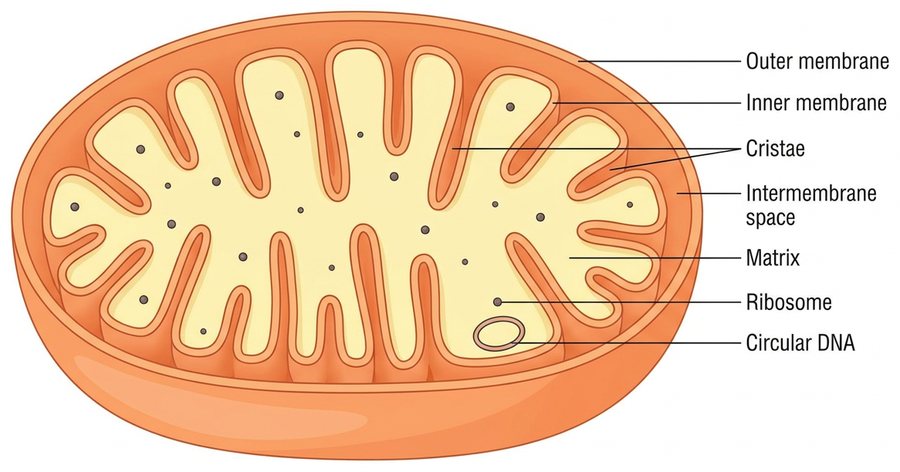
Cut-away drawing of a mitochondrion labelled outer membrane, inner membrane, cristae, intermembrane space, matrix, ribosome and circular DNA
Figure 5.7 A mitochondrion cut open to show the folded cristae and the matrix.
Foundations of Biology12
Ch. 5 · Cell Structure5.4 Mitochondria

The matrix contains the enzymes of the Krebs cycle, along with circular DNA and 70S ribosomes. This allows mitochondria to make some of their own proteins.

Because their DNA and ribosomes resemble those of bacteria, most biologists think mitochondria were once free-living bacteria that were taken in by a larger cell. This idea is called the endosymbiotic theory.

The electron transport chain on the cristae produces most of the ATP made during respiration.

13Foundations of Biology
Ch. 5 · Cell StructureBiology
5.5 Where mitochondria are found

Very active cells, such as muscle cells and sperm, contain many mitochondria. Mature red blood cells have none.

The number of mitochondria in a cell can change. Regular endurance training, for example, increases the number of mitochondria in skeletal muscle cells.

Table 5.2 Mitochondria in different cells
Cell typeMitochondria
Muscle cellMany
Sperm cellMany, in the midpiece
Liver cellUp to 2,000
Red blood cellNone
Foundations of Biology14
Flashcards

Eight ways to test yourself. One deck that remembers for you.

Flip a card, fill a blank, label a diagram, put steps in order, match pairs or answer out loud. Rate each card, and it comes back just before you would forget it.

The science of studying

Study the way research says. StudyTab does the hard part.

A century of memory research agrees on a handful of techniques. Most students never use them, because they take planning. StudyTab builds them into every note, card and review.

One fact, followed for a month“The mitochondrion makes ATP.”

MemoryFragile

    Why it works

    In StudyTab

    Stay on track

    From exam date to today. Every day planned for you.

    Pick your exam and StudyTab lays out every day until it. One tap builds today's sessions, the timer keeps your focus, and your streak and activity show it adding up.

    Good evening, Priya18 cards due across 4 decks
    Goodbye, app chaos

    Nine apps open at 2 am. Or one.

    Most students study across a pile of apps that never talk to each other. StudyTab puts all of it in one place.

    9 places to check · nothing connected

      Close the other eight tabs. Start with one.

      • Free forever plan
      • No credit card
      • Phone, tablet or laptop
      Start studying free

      Already have an account? Log in